Visar inlägg med etikett unprocessed trauma. Visa alla inlägg

8/30/2009

The study of psychological trauma – one of episodic amnesia…

Judith Lewis Herman writes in the beginning of the chapter “A Forgotten History” in her book “Trauma and Recovery – From Domestic Abuse to Political Terror” that:

“The study of psychological trauma has a curious history – one of episodic amnesia. Periods of active investigation have alternated with periods of oblivion. Repeatedly in the past century, similar lines of inquiry have been taken up and abruptly abandoned, only to be rediscovered much later. Classic documents of fifty or one hundred years ago often read like contemporary works. Though the field has in fact an abundant and rich tradition; it has been periodically forgotten and must be periodically reclaimed.”

An explanation why works like Alice Miller’s aren’t translated to Swedish today?

Herman also writes according to World People’s Blog:

Diagnostic Mislabeling: The tendency to blame the victim has strongly influenced the direction of psychological inquiry.

It has led researchers and clinicians to seek an explanation for the perpetrator’s crimes in the character of the victim. In the case of hostages and prisoners of war, numerous attempts to find supposed personality defects that predisposed captives to 'brainwashing' have yielded few consistent results.”

2/22/2009

Traumas - a non issue…


I read something interesting, true and worth noting and spreading, on the blog Do nothing day. Anja writes about an interview with a victim for child abuse, and winner of a prize for freedom of speech, where she especially liked the wording

“What I was exposed to as a child has been a non-issue.”

Anja thinks that traumas really are non-issues, not just in health care but in our whole culture. Of course, sufferings are paid attention to when they occur, like for instance when a tsunami happens. But we don’t really know what we shall do with the trauma when it has become “old”. And that’s exactly what’s problematic with traumas – [if] they don’t pass off as quickly as we expect, maybe they never pass off – and chronic states have very low status both in health care and in our culture in general.


And people telling about abuse (that sort of traumas) they experienced as children is really non-issues. And those sorts of traumas are the ones that becomes chronic and later easily or most often becomes added with more traumas. And is also the reason why people have difficulties recovering from later traumas.


But with proper and adequate help a traumatized can recover I think... Unfortunately I think few really get this help. Some sorts of traumas are non-themes exactly as Anja and Sigrun says/writes! Surrounded with a Wall of Silence.


And this is the reason, or an explanation, why people like for instance Jordan Riak and Paula Flowe have problems getting economical support for their work; preventing child abuse to happen!? At the same time people are more than readily prepared paying to other causes.


Those themes are non-issues in the world!?


About Jordan Riak in Wikipedia, see here. Also see Judith Lewis Herman on this topic.

11/21/2008

Children are always innocent…

children from the Noisy Village.

From a leader with the title “Children are always innocent” this week in a local newspaper here I want to translate the content, and then add some comments and brief thoughts on this leader. So here is my amateur translation to English first:


In the beginning of this millennium we suddenly started to talk about apathetic refugee children here in Sweden. Small children from former Yugoslavia and from Central Asia were lying there beyond contact and had to be fed with probes or tubes. Suddenly they emerged in media and released an endless amount of reactions, not only compassionate but unfortunately also more or less racist.


At last the Swedish Migration Board reported some parents to the police, parents whom they suspected were manipulating their kids to resignation so they should be allowed to stay in the country. A Government investigation was appointed which fantastically enough asserted that the phenomenon was Swedish and at least indicated that the parents could be the guilty ones to the problem.


What sort of children was this? Now a proper medical investigation of 33 of these children has come. And the picture that is emerging is exactly as horrible as one could fear: here are children whom have seen their mothers being group raped, who have been raped themselves, and been exposed for severe threats of violence during the earliest years. Pictures from the hell shortly said.


How can a child handle so traumatic experiences depends on many different things, among them are the parents’ attitude.


But one thing is clear: the talk about that the apathetic children should have been made sick by their parents can become dismissed: the apathy has its roots in experiences so horrible that most of us can’t even imagine them.


The investigation also shows that apathy isn’t a specific Swedish phenomenon: it can be sorted medically under the stress reaction PRS, pervasive refusal syndrome.


So what can we learn from this? the leader writer wondered.


The most important lesson is that the one seeing a really sick child in front of her/him, who has lost all its interest for the surrounding world, has to realize that what one then sees is the end station in a long row of events. No child can play sick in this way. And no normally functioning parent would bring her/himself to cause such a state in her/his own child.


When I was writing this I came to think a phone talk I had the other evening with a now middle age woman. Where she revealed her life story, of which I have got pieces earlier. This woman is born in one of our Scandinavian countries to parents who were socially functioning, members of a church.


She was spanked and sexually abused, but managed to study at the University and was quite successful I think. But has never managed to work after those studies. And never gotten proper help from therapists or the psychiatric care to process (all) her traumas.


In her twenties she got a child but landed in a deep depression and sought herself to a psychiatric ward. She could never be there for her child and feels extremely sad over this. She lay in bed apathetic. Couldn’t enjoy being mother.


When her daughter was around five years she divorced her father, but she couldn’t take care of her daughter herself (or at all) because she had no powers doing so, still in depression and emotionally handicapped. Her father took care of her, and it looks like the daughter has grown up to a healthy individual! This is something fantastic! But her mother wonders what her daughter has been through and maybe keeps inside her. Experiencing such a mother so earl in life and actually being abandoned by her so early (how many dads have similar concerns strikes me when I am writing this).


I think there are things happening much closer than we believe. Things we can’t imagine in our wildest fantasies, with people seemingly living normal lives. With people living in a country who is not in war, like our Scandinavian. Children experiencing horrible things. I am not sure we can beat our breasts!

Yes, I agree that the children are always innocent... But, there is a but... About parents, and their behaviors...

You find the leader here too.

6/10/2008

Traumas and changes in the brain...

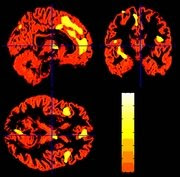
Areas in the brain that has minor volume of grey matter, among those who were in the nearness of the terrorist-attack. All areas, which are light in colour on this picture, are areas that are connected with emotions. (Foto: Barbara Ganzel/Cornell University)

”Traumas can change the brain” was the heading to an article I got a link to. It stands that evil experiences as those happening September 11 at World Trade Center can reduce the amount of grey matter in the brain. See "Resilience after 9/11: Multimodal neuroimaging evidence for stress-related change in the healthy adult brain" andBrain's gray cells appear to be changed by trauma of major events like 9/11 attack, a study suggests.

Unprocessed trauma makes the brain vulnerable for new trauma? The less traumatized (or the more help an individual has gotten to process difficult things from early in life r later in a successful, proper therapy) the less vulnerable, the more easily you can process difficult life-events later. What Jenson says!! Unprocessed traumas influence our ability to process later traumas so we can go on in life better.

I had to look in Jenson’s book again. Yes, she writes at page 36 that another serious consequence of a permanent suppression is the distortion (förvrängning) the unconscious forces us to. She means that we aren’t aware of what and how we are actually behaving and doing (these defence and survival strategies comes automatically, and have become as a part of ourselves, in my understanding and interpretation of her, we need to learn to recognize them first), for instance trying to change oneself in hope of getting appreciation and/or be spared abuse and violations.

An inborn ability to process experiences is damaged. And she means that to be capable of processing things realistically and in full a person needs to see clearly what’s happening in a given situation. When there is a high degree of denial clear perception is rather exception than rule. The unconscious distorts the individual’s experiences without her/him being aware of it.

Suppression damages a very important human capacity namely the ability to process experiences, something which is important for a sound, satisfying life. And the results of these inabilities are often quite tragic I would frankly say.

Of course this influences later difficult experiences and our capacity to process them constructively.

And that is what the researchers have seeing the research that is referred to?

See wikipedia according grey matter in the brain, and the ACE-reporter nr. 4 ”Adverse Childhood Experiences and Stress: Paying the Piper” where it for instance stands:

“…the ACE Study data [was analyzed] against demonstrated neurobiological defects that result from early trauma, changes to areas of the brain that mediate mood, anxiety, healthy bonding with other people, memory, and even where our bodies store fat.

After careful analysis, what they found is that ‘early experiences can have profound long-term effects on the biological systems that govern responses to stress…Disturbances [in neuron-development] at a critical time early in life may exert a disproportionate influence, creating the conditions for childhood and adult depression, anxiety, and post-traumatic stress symptoms.’

These shared findings have ‘the potential to unify and improve our understanding of many seemingly unrelated, but often co-morbid [occurring at the same time] health and social problems that have historically been seen and treated as categorically independent in Western culture.’

Why is this important? First, it is important to recognize that our ‘functional neuroanatomical and physiologic systems are interactive and integrated and that behaviors and health problems cannot generally be attributed to the function of any single or particular system.’ Our bodies’ systems work together. Therefore, treating one aspect of a problem, without addressing the other aspects, cannot possibly solve the problem completely.

Comprehending this essential relationship can help improve both preventive and primary care medicine, giving patients and their caregivers the information they need to achieve the best possible health and social outcomes.

Second, this convergence of colleagues and their data ‘adds support for numerous effects of childhood adverse experiences on physical health.

Stress is known from animal studies to be associated with a broad range of effects on physical health, including cardiovascular disease, hypertension, hyperlipidemia, asthma, metabolic abnormalities, obesity, infection and other physical disorders.’ These findings provide the sort of substance that governments, organizations, and people in general typically require to become engaged, and to take action.

Without scientific data, the long-term effects of childhood trauma are otherwise easily brushed aside in favor of a more comfortable and convenient denial of the problem.

Third, we now know that ‘retrospective reports of childhood abuse [that was documented at the time of its occurrence] are likely to underestimate actual occurrence…[due to] effects of traumatic stress in childhood on the hippocampus’. In other words, the incidence of child abuse is probably much greater than is reported, and even greater than remembered and acknowledged by the victims themselves. Not only is such trauma protected by secrecy and shame, but by the function of our own brains.

Equally important, this multi-disciplinary approach to research encourages future collaboration among scientists, all working at solving different pieces of what we are beginning to understand is the same puzzle. As the puzzle takes shape, the pipers lose ground.”

In wikipedia it stands about the grey matter:

“Grey matter is distributed at the surface of the cerebral hemispheres (cerebral cortex) and of the cerebellum (cerebellar cortex), as well as in the depth of the cerebral (thalamus; hypothalamus; subthalamus, basal ganglia - putamen, globus pallidus, nucleus accumbens; septal nuclei), cerebellar (deep cerebellar nuclei - dentate nucleus, globose nucleus, emboliform nucleus, fastigial nucleus), brainstem (substantia nigra, red nucleus, olivary nuclei, cranial nerve nuclei) and spinal grey matter (anterior horn, lateral horn, posterior horn).

The function of gray matter is to route sensory or motor stimulus to interneurons of the CNS in order to create a response to the stimulus through chemical synapse activity. Gray matter structures (cortex, deep nuclei) process information originating in the sensory organs or in other gray matter regions. This information is conveyed via specialized nerve cell extensions (long axons), which form the bulk of the cerebral, cerebellar, and spinal white matter.”

See earlier postings on the brain and also the posting on hysteria and neocortex.
