10/27/2009

Violations, punishments, trials to make the child obedient and what that has caused and causes in the adult life, in the society and the world…

Have come to think about violations again. Searched for old postings on this here. Found one in which you can read about the American therapist Jean Jenson on what she thinks violations are, inspired by Pia Mellody’s ideas. I use the "Summary" I made in English in this posting and have made small changes and additions in it.

Yes, different treatments were and are used as punishments and to make the child obedient. Used to silence it etc. And we take this with into adult life if we don’t get help to process them and these early experiences cause us a lot of problems depending on the degree we have gotten help to process them. Sometimes we have huge problems.

And some play this out on other people close to them who are in lower positions. Women usually on their kids because they haven’t gotten other power positions in this world. Men play them out on wife and kids if they have any, and/or at work depending on the power position he has there.

Miller speculates on what had happened if Hitler had had kids, i.e. if he had had objects to abreact on at home. Had he become that world tyrant as he became?

And what happen with those whose voices were entirely silenced? Who maybe never got a voice and didn’t get the opportunity to express themselves. And with those who had a voice and got the opportunity to express themselves, but in a, from the truth, disguised way.

About this Miller speculates in one of her last books, “The Body Never Lies – the Lingering Effects of Cruel Parenting.” About authors and other artists who expressed themselves, sometimes very bravely, but never really called early experiences in question. They became sick. Also see what the Norwegian physician Anna-Luise Kirkengen and her findings in this respect.

To come back to Jenson and Mellody; they mean it isn’t only a question of physical or sexual violations but also of emotional violations. Of disrespect even emotionally. Verbal violence, demands on perfectionism, neglect, abandonment and “exaggerated control of reality” (the child is told what to wear, what friends to have, how to think [and not think], what it shall believe in), they see all these things as violations.

And they also write about the phenomenon emotional incest, to use the child instead of the partner or another grown up as the intimate or confidant, something the child couldn’t escape or say no to, and something Mellody thinks is very common in our cultures, and what is a violation too according to them, an infringement on the child's integrity.

Jenson writes about an emotionally not accessible father, what that means to the child; giving it a feeling of not being good enough.

A mother “sick” because she was drunk and the children were hindered to disturb her or "give her troubles" [this mother wasn’t there for her kids either, absent, if not physically so emotionally/psychologically]. Threatened by their father if they did “disturb” her, with being spanked, and how THAT felt. Maybe so painful so they had to suppress that feeling. Probably because of their whole history and other experiences with their caregivers.

They write about growing up with many siblings, where each child didn’t get enough attention or time. That was an emotional violation. Neglect. Giving the child a feeling of being forgotten, and being unimportant.

And about a family in which all seemed to be kind and friendly (and maybe even caring, at least on the surface), but when the child tried to communicate something that worried it its mom used to change subject (not listening or not wanting to listen) and dad sat hidden behind the newspaper (not wanting to listen either, also avoiding the problem). An emotional violation. Being abandoned. Giving the child a feeling of being ignored and not being good enough (to be listened to, being taken seriously, being seen and cared for) etc.

The right to have ones feelings, emotions, thoughts, and to express them loudly just as anybody else, so long as you don’t harm anybody. Not become silenced. Again.

Men have had the power and money (material wealth), that is things that have made it and still makes it easier for them to raise their voices (and see the Norwegian Berit Ã…s with her Master Suppression techniques).

10/18/2009

On the King of Pain...


[Slightly edited October 19]. About one of the effects of child-rearing techniques read “The King of Pain, Chapter 6 of Republican Gomorrah” by Max Blumenthal, 2009, Nation Books, NY.

And more on James Dobson, with his “Focus on the Family”.

Also read "Passion and Purpose for Parents in every season" , “James Dobson: Focusing on Himself-

How James Dobson, leader of Focus on the Family, sets himself up as the moral authority of the nation -- taken from his own words and from other media reports" by Brian Elroy McKinley:

“Move over George Washington. James Dobson, founder of Focus on the Family, wants to take your place as father of our country. But rather than being a true father -- one who helps us mature into individuals -- he is little more than another Pharisee, setting himself up as a religiously-based political dictator bent on getting us to support his personal view of legislated morality.

And what's even worse, Dobson goes to great length to use Scripture to support his view, and yet according to Time magazine he doesn't even have any formal theological training. In short, Dobson, using his position as a radio psychologist, has set himself up as our moral authority and asks us all to blindly follow.”

See quotations by James Dobson.

See about the book ”Republican Gomorrah: Inside The Movement That Shattered The Party” by Max Blumentahl.

10/15/2009

Positive thinking...

The Daily Show With Jon StewartMon - Thurs 11p / 10c
Barbara Ehrenreich
www.thedailyshow.com
Daily Show
Full Episodes
Political HumorRon Paul Interview


Read the article ”How Positive Thinking Wrecked the Economy” and about her new book ”Bright-sided: how the relentless promotion of positive thinking has undermined America” and also the article ”The Medicated Americans: Antidepressant Prescriptions on the Rise. Close to 10 percent of men and women in America are now taking drugs to combat depression. How did a once rare condition become so common?”

And also this artikel.

Addition October 17: Quite ironically and thinking loudly here. Yes, these positive thinking demands can be to scorn people with real and big troubles… All kinds of troubles the environment doesn’t want to deal with? Neither here-and-now problems (structural) nor other problems.

Maybe responsibilities (for the community, structural and human) the environment pushes away? The flipside of the individualism (or maybe the reason for the sort of individualism we see today)? (Can't both exist side by side; can't individuals AND the group exist side by side, WITH true, genuine respect for the individual who doesn't become invisible in the crowd? Where you both see and hear the individual? Wouldn't that be the healthiest community?)

Yeah, "positive thinking" can become (and has been and is) an oppression tool. But you should be entitled to think positively ONLY when there are reasons for it.

Of course, with all due respect, there are people who really need "help" (using the word "help" sounds like you are looking down, from above, on the person with troubles) with their negative thinking, i.e. real, genuine depressions, depressions there are (always) reasons for I think. Maybe reasons we don't want to know about or deal with however. Because they are touching our own early experiences (experiences that seem to be universal, as we all share more or less, experiences that aren't unavoidable however!).

Things not even professionals want to deal with really, either than on a not too, for their peace of mind, threatening level?

Also read "Traumatic childhood experiences take 20 years off life expectancy."

Addition in the evening (slightly updated October 18): In an article, on a new book about happiness by the Swedish neoliberal Johan Norberg, you can read that the Swedes were one of the happiest people in the world as recently as 2004. International inquiries on self appreciated happiness have shown this. But all Swedes weren’t equally happy. Happiness depended on class, gender, ethnicity, age, workplace and where you lived.

Drugs give ecstasies and are a global commodity of great proportions and give short term relief. It strikes against all, but the greatest maladjustment occurs in the most exposed and vulnerable parts of the society, in the suburbs and in industrial communities with high unemployment rates.

However, about those circumstances Norberg keeps quiet. He prefers to call us a “we.” And he on the contrary thinks that we are whining about things. Complaining without reasons.

Quite ironically: Where has he gotten this idea from? And is this really true? And what does he know about peoples' living conditions?

It was this with empathy deficits…

The article writer, however, finds that we often don’t give the show away (we are keeping the mask), and play cheerful sides up of ourselves. How many times have we answered sincerely on the question “How are you?” or “How are things going?”

Of course you can’t buy happiness for money. An unreflecting chase on higher standard doesn’t create any happiness, but instead enviousness and bitterness.

Even Norberg (surprisingly) writes that it’s directly damaging for the health to have the only prime motive force to earn money.

The unrestrained neoliberal capitalism, with maximization of profits as the only goal, doesn’t create happiness either. It presupposes a big social maladjustment and great social tensions.

A society with increasing unfairness’s nobody gains on.

In our hyper commercial age the chase for happiness has created a new line of business for hearty self-help books, lifestyle magazines about food, health, exercise, positive thinking and beauty.

"The corporation 'I' ["me, me, me! I want, I have to..."]" is valid everywhere. It’s up to you to find the happiness yourself and the meaning with the existence. And accordingly you just have yourself to blame. In that way the neoliberals have managed to push the conception solidarity away. I.e. to see yourself in other people, to be there for other people, because in fact, tomorrow it can be you who need a helping hand.

Norberg is drawing the wrong conclusion that the ego has to come first. An adult with a healthy maturity doesn’t have a big ego? Has a sound egoism? And is capable of protecting her/himself when necessary, neither more nor less than necessary? And is capable of doing this without harming anybody, neither him/herself or other people.

This neoliberal concept of the world is foremost seeing to selfish needs. But why not try to make another person happy without any demands on services in return?

The Dutch therapist Ingeborg Bosch actually writes about this. That a person with a healthy development can do things for other people and give without demanding anything back. And I think she is right. But it’s definitely also sound to start to call things in question at a certain point, if there’s ONLY one-way-giving!? It’s not sound NEVER asking anything back! As if you were invisible and had no needs. Yes, denying needs can be a defense too.

10/10/2009

A forestalling Nobel Peace Prize...


[Updated October 13, and 17 with a video in the end of the posting]. Watch this video on a Swedish newspaper's website.

A Swedish blogger thinks that the Nobel Peace Prize to president Barack Obama is a forestalling Peace Prize.

He writes that our era is characterized by forestalling war, so what’s more natural than a forestalling Nobel Peace Prize?

The popular doctrine about forestalling war has probably resulted in that politicians have started to think more and more like stockbrokers. The stock market is governed by what profits the market believes the company is going to generate in the future, not by the company’s actual results.

It’s the same with the security policy situation this blogger thinks, politicians act from what their beliefs about the future are, and thus they start forestalling wars.

So now when the Norwegian Nobel-committee applies this stock trading logic it shows that it is modern. The Nobel Peace Prize will make it easier for Obama to continue being a Peace president and keep the credibility.

Yes, hopefully it does…

See the Nobelprize.org site. And the youtube-page.

Addition October 13: But if Obama endorses corporal punishment for kids it's wrong to give him the Peace Prize... See this speech by the Swedish childbook author Astrid Lindgren.

Never Violence!

Delivered upon children's author Astrid Lindgren's acceptance of the German Booksellers Peace Prize in Frankfurt, Germany, October 22, 1978

Dear friends!

What I must do first is thank you, and this I do with all my heart. The German Booksellers' Peace Prize has such a luster around it and is such a great honor to receive that one almost totters when it is put into one's hands. And now I stand here, where so many wise men and women have stood during the years, putting their thoughts and hopes forth about the future of humanity and about the eternal peace that we all are longing for. What can I say that hasn't been said already in a better way than I can?

To talk about peace is to talk about something that doesn't exist. Real peace does not exist on our earth and has never existed other than as a goal that we evidently cannot reach. So long as humanity has lived on this orb it has dedicated itself to violence and war, and the fragile peace as it now exists is constantly threatened. At this moment the whole world is living in fear of a new war, a war that will destroy us all. At the prospect of this threat more people than ever are working for peace and disarmament—that is true. This could be a hope. But it is difficult to be hopeful. The politicians gather in large crowds at top-level meetings and talk so warmly for disarmament, but the only disarmament they desire is that of someone other than themselves. “Your land shall disarm, not mine!” No one wants to start with oneself—no one dares to start—because all are so afraid and have so little confidence in other's will to work toward peace. And while one disarmament conference replaces another, the most insane rearmament in humanity's history takes place. It is not strange that we are all afraid. Either we live in the East, North or South; either we live in a great and powerful country or a small, neutral one. But we know that a big new war would hit the whole of humanity, and whether it is in a neutral or not neutral heap of ruins that I lie dead can make no big difference.

Mustn't we, after all those thousands of years of constant wars, ask ourselves if it is because of some kind of construction fault in the whole species of man that we always take up violence? And ask if we are doomed to come to our end for our aggression's sake? We all want peace. Isn't there a possibility then that we can change before it is too late? That we can learn to dissociate ourselves from violence? Simply try to become a new strain of human beings? But how should that come about? And where should we, in that case, start?

I think we have to start from the foundation. With the children. You have given an author of children's books a peace prize; you must not expect any big political views or suggestions for international solutions to the problems. I want to talk about the children, my worries for them and my expectations for them. Those who are children now shall take over the handling of the world, if there is anything left of it. They shall decide between war and peace and what sort of society they shall have; if they prefer one in which violence continues to escalate or one in which human beings live in peace and community with each other.

Is there on the whole any hope that they shall be able to create a more peaceful world than what we have succeeded with? Why have we failed so badly in spite of all good will? I recall what a shock it was for me when, still very young, I suddenly realized that those who governed countries and the world's destiny were no Gods with a superior outfit or clear, divine sight. They were human beings with the same weaknesses as I. But they had power, and they could in each moment come to the most ill-fated decisions by the impulses that ruled them. If things were against us, it could be war because of one single human being's desire for power or revenge or vanity or triumph or—what seemed to be the most common—blind faith in violence as the most efficient aid in all situations. And in the same way, one single good human being filled with consideration could ward off catastrophes, just through being good and filled with consideration and through repudiating violence.

The conclusion from this could be: it is individual human beings who determine the destiny of the world. And why aren't all good and filled with consideration then? Why are there so many who only want violence and power? Is there an innate evil will in some? I couldn't believe it then, and I don't believe it even this day. The intelligences—the gift of reason—are innate, but in a newborn baby no seed lies within from which it will automatically grow good or evil. What determines whether a child will become a warm, open, trusting human being with the ability to commune with others or a cold, destructive loner is decided by the ones that welcome the child into the world and either teach it what love is or leave it to be shown.

Goethe has said “Überall lernt man nur von dem, den man liebt”, and then it must be true. A child that is lovingly met and who loves its parents learns a loving attitude to its surrounding world, and keeps this basic attitude throughout life. Which is good, even if he or she comes to belong to those deciding the world's destiny. And should, contrary to expectation, he or she happen to become one of those deciding the world's destiny, that's good luck for us all—if their basic attitude is love and not violence. Future statesmen and politicians are formed in their character before they are even five years old—that's horrible but it is true.

And if we now look back at how children have been treated and raised so far as we can follow it through the times, hasn't it too often been a question of breaking their will with violence of some kind, either physical or psychological? How many children haven't gotten their first lesson in violence “von denen, die man liebt”, their own parents—and then passed this teaching on from generation to generation? “Spare the rod and spoil the child” you can read in the Old Testament. This, ever since written, many fathers and mothers have believed. They have diligently swung the birch and called it “love”. But all those “ruined boys” of whom there are so many at this moment in the world—the dictators, the tyrants, the oppressors, the tormentors of human beings—how was their childhood? That you ought to do some research into. I believe that behind most of them there is a tyrannic father or other raiser with a birch or a rod in the hand.

Mustn't you then become despaired when there are voices screaming for retrogression to old authoritarian systems? That is what is going on in many places in the world. Those who blame “too much freedom” and “too little strictness” in upbringing for youthful “misbehaviors” now want “harder grips” and “tightened reins”. This is to use Beelzebub to drive out the Devil and will only lead to more violence and bigger and more dangerous gulfs between the generations in the long term. Those much longed for “harder grips” would possibly “achieve” a superficial effect that its advocates could interpret as an improvement. Until, that is, they are gradually forced to notice that violence breeds violence—as it has always done.

Many parents are worried by those new signals and have begun to wonder if perhaps they have done wrong. Is an anti-authoritarian upbringing something objectionable? It is only if it becomes misunderstood.

An anti-authoritarian upbringing doesn't mean that children shall be left to care for themselves or to do precisely what they want. It doesn't mean they shall grow up without norms, by the way, or that they will reject them. Both children and adults need norms for conduct, and children learn more from their parents' example than from anything else. Of course a child shall have respect for its parents, but indeed—parents shall also have respect for their children and not abuse their natural advantage over them. A mutual, loving respect—that one wishes for both parents and for all children.

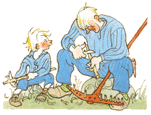
And for all those who are now screaming so eagerly for harder grips and tighter reins, I would want to tell you what an old lady once told me. She was a young mother when the common belief was “Spare the rod and spoil the child”. She hadn't been fully convinced of it, but at one time her little boy had done something, so she decided he “needed” a spanking—the first of his life. She said to him that he had to go out and find a birch for her. The little boy left and was out for a long time. At last he came back, crying, and said:”I didn't find any birch but here you have a stone you can throw on me.” Then she too began to cry, because suddenly she saw everything with the child's eyes. The child had thought “If my mother in fact wants to hurt me, then she can as well use a stone.” She put her arms around him and they cried together for a while. And then she put the stone on a shelf in the kitchen, and there it laid as an eternal reminder of the promise she gave herself at that moment: “Never violence!”

Well, if we now raise our children without violence or tight reins of any kind, do we then get a new human species living in eternal peace? Only a child book author can hope something so silly. I know it is a utopia. And of course there is so much else in our poor, sick world that has to be changed so that there can be peace. But we have, in the here and now—even without war—so incomprehensibly much cruelty and violence on earth. The children are indeed aware of it. They see and hear and read about it daily, and must think violence is a natural state. Mustn't we, at least in our homes and through our own examples show that there are other ways of living? Maybe it would be a good idea if we were to put a stone on the kitchen shelf as a reminder for children and ourselves: Never violence! It would yet maybe at last be a small contribution to the peace of the world.

Addition October 17:


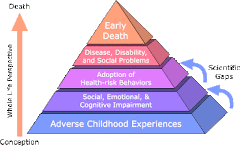
And even if violence doesn’t lead to regular or big-scale wars it affects our health and wellbeing, something that has been shown by the ACE-study. Also see the article “Social service agencies, public health communities use ACE, but not medical community.”