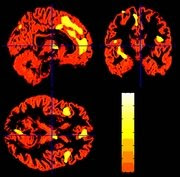
Areas in the brain that has minor volume of grey matter, among those who were in the nearness of the terrorist-attack. All areas, which are light in colour on this picture, are areas that are connected with emotions. (Foto: Barbara Ganzel/Cornell University)
”Traumas can change the brain” was the heading to an article I got a link to. It stands that evil experiences as those happening September 11 at World Trade Center can reduce the amount of grey matter in the brain. See "Resilience after 9/11: Multimodal neuroimaging evidence for stress-related change in the healthy adult brain" and ”Brain's gray cells appear to be changed by trauma of major events like 9/11 attack, a study suggests.”
Unprocessed trauma makes the brain vulnerable for new trauma? The less traumatized (or the more help an individual has gotten to process difficult things from early in life r later in a successful, proper therapy) the less vulnerable, the more easily you can process difficult life-events later. What Jenson says!! Unprocessed traumas influence our ability to process later traumas so we can go on in life better.
I had to look in Jenson’s book again. Yes, she writes at page 36 that another serious consequence of a permanent suppression is the distortion (förvrängning) the unconscious forces us to. She means that we aren’t aware of what and how we are actually behaving and doing (these defence and survival strategies comes automatically, and have become as a part of ourselves, in my understanding and interpretation of her, we need to learn to recognize them first), for instance trying to change oneself in hope of getting appreciation and/or be spared abuse and violations.
An inborn ability to process experiences is damaged. And she means that to be capable of processing things realistically and in full a person needs to see clearly what’s happening in a given situation. When there is a high degree of denial clear perception is rather exception than rule. The unconscious distorts the individual’s experiences without her/him being aware of it.
Suppression damages a very important human capacity namely the ability to process experiences, something which is important for a sound, satisfying life. And the results of these inabilities are often quite tragic I would frankly say.
Of course this influences later difficult experiences and our capacity to process them constructively.
And that is what the researchers have seeing the research that is referred to?
See wikipedia according grey matter in the brain, and the ACE-reporter nr. 4 ”Adverse Childhood Experiences and Stress: Paying the Piper” where it for instance stands:
“…the ACE Study data [was analyzed] against demonstrated neurobiological defects that result from early trauma, changes to areas of the brain that mediate mood, anxiety, healthy bonding with other people, memory, and even where our bodies store fat.
After careful analysis, what they found is that ‘early experiences can have profound long-term effects on the biological systems that govern responses to stress…Disturbances [in neuron-development] at a critical time early in life may exert a disproportionate influence, creating the conditions for childhood and adult depression, anxiety, and post-traumatic stress symptoms.’
These shared findings have ‘the potential to unify and improve our understanding of many seemingly unrelated, but often co-morbid [occurring at the same time] health and social problems that have historically been seen and treated as categorically independent in Western culture.’
Why is this important? First, it is important to recognize that our ‘functional neuroanatomical and physiologic systems are interactive and integrated and that behaviors and health problems cannot generally be attributed to the function of any single or particular system.’ Our bodies’ systems work together. Therefore, treating one aspect of a problem, without addressing the other aspects, cannot possibly solve the problem completely.
Comprehending this essential relationship can help improve both preventive and primary care medicine, giving patients and their caregivers the information they need to achieve the best possible health and social outcomes.
Second, this convergence of colleagues and their data ‘adds support for numerous effects of childhood adverse experiences on physical health.
Stress is known from animal studies to be associated with a broad range of effects on physical health, including cardiovascular disease, hypertension, hyperlipidemia, asthma, metabolic abnormalities, obesity, infection and other physical disorders.’ These findings provide the sort of substance that governments, organizations, and people in general typically require to become engaged, and to take action.
Without scientific data, the long-term effects of childhood trauma are otherwise easily brushed aside in favor of a more comfortable and convenient denial of the problem.
Third, we now know that ‘retrospective reports of childhood abuse [that was documented at the time of its occurrence] are likely to underestimate actual occurrence…[due to] effects of traumatic stress in childhood on the hippocampus’. In other words, the incidence of child abuse is probably much greater than is reported, and even greater than remembered and acknowledged by the victims themselves. Not only is such trauma protected by secrecy and shame, but by the function of our own brains.
Equally important, this multi-disciplinary approach to research encourages future collaboration among scientists, all working at solving different pieces of what we are beginning to understand is the same puzzle. As the puzzle takes shape, the pipers lose ground.”
In wikipedia it stands about the grey matter:
“Grey matter is distributed at the surface of the cerebral hemispheres (cerebral cortex) and of the cerebellum (cerebellar cortex), as well as in the depth of the cerebral (thalamus; hypothalamus; subthalamus, basal ganglia - putamen, globus pallidus, nucleus accumbens; septal nuclei), cerebellar (deep cerebellar nuclei - dentate nucleus, globose nucleus, emboliform nucleus, fastigial nucleus), brainstem (substantia nigra, red nucleus, olivary nuclei, cranial nerve nuclei) and spinal grey matter (anterior horn, lateral horn, posterior horn).
The function of gray matter is to route sensory or motor stimulus to interneurons of the CNS in order to create a response to the stimulus through chemical synapse activity. Gray matter structures (cortex, deep nuclei) process information originating in the sensory organs or in other gray matter regions. This information is conveyed via specialized nerve cell extensions (long axons), which form the bulk of the cerebral, cerebellar, and spinal white matter.”
See earlier postings on the brain and also the posting on hysteria and neocortex.

 Corporal punishment prohibited in schools and the home (green) Corporal punishment prohibited in schools only (blue) Corporal punishment not prohibited (red)




 Inlägg


