Visar inlägg med etikett the brain. Visa alla inlägg

8/27/2009

Child abuse and its effects…


Corporal punishment prohibited in schools and the home (green) Corporal punishment prohibited in schools only (blue) Corporal punishment not prohibited (red)


Read “What doesn't kill you makes you stronger: true or false? A discussion of the effects of child abuse” by Sarah Eberhardt and also read about corporal punishment in Europe and USA.


6/10/2008

Traumas and changes in the brain...

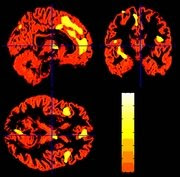
Areas in the brain that has minor volume of grey matter, among those who were in the nearness of the terrorist-attack. All areas, which are light in colour on this picture, are areas that are connected with emotions. (Foto: Barbara Ganzel/Cornell University)

”Traumas can change the brain” was the heading to an article I got a link to. It stands that evil experiences as those happening September 11 at World Trade Center can reduce the amount of grey matter in the brain. See "Resilience after 9/11: Multimodal neuroimaging evidence for stress-related change in the healthy adult brain" andBrain's gray cells appear to be changed by trauma of major events like 9/11 attack, a study suggests.

Unprocessed trauma makes the brain vulnerable for new trauma? The less traumatized (or the more help an individual has gotten to process difficult things from early in life r later in a successful, proper therapy) the less vulnerable, the more easily you can process difficult life-events later. What Jenson says!! Unprocessed traumas influence our ability to process later traumas so we can go on in life better.

I had to look in Jenson’s book again. Yes, she writes at page 36 that another serious consequence of a permanent suppression is the distortion (förvrängning) the unconscious forces us to. She means that we aren’t aware of what and how we are actually behaving and doing (these defence and survival strategies comes automatically, and have become as a part of ourselves, in my understanding and interpretation of her, we need to learn to recognize them first), for instance trying to change oneself in hope of getting appreciation and/or be spared abuse and violations.

An inborn ability to process experiences is damaged. And she means that to be capable of processing things realistically and in full a person needs to see clearly what’s happening in a given situation. When there is a high degree of denial clear perception is rather exception than rule. The unconscious distorts the individual’s experiences without her/him being aware of it.

Suppression damages a very important human capacity namely the ability to process experiences, something which is important for a sound, satisfying life. And the results of these inabilities are often quite tragic I would frankly say.

Of course this influences later difficult experiences and our capacity to process them constructively.

And that is what the researchers have seeing the research that is referred to?

See wikipedia according grey matter in the brain, and the ACE-reporter nr. 4 ”Adverse Childhood Experiences and Stress: Paying the Piper” where it for instance stands:

“…the ACE Study data [was analyzed] against demonstrated neurobiological defects that result from early trauma, changes to areas of the brain that mediate mood, anxiety, healthy bonding with other people, memory, and even where our bodies store fat.

After careful analysis, what they found is that ‘early experiences can have profound long-term effects on the biological systems that govern responses to stress…Disturbances [in neuron-development] at a critical time early in life may exert a disproportionate influence, creating the conditions for childhood and adult depression, anxiety, and post-traumatic stress symptoms.’

These shared findings have ‘the potential to unify and improve our understanding of many seemingly unrelated, but often co-morbid [occurring at the same time] health and social problems that have historically been seen and treated as categorically independent in Western culture.’

Why is this important? First, it is important to recognize that our ‘functional neuroanatomical and physiologic systems are interactive and integrated and that behaviors and health problems cannot generally be attributed to the function of any single or particular system.’ Our bodies’ systems work together. Therefore, treating one aspect of a problem, without addressing the other aspects, cannot possibly solve the problem completely.

Comprehending this essential relationship can help improve both preventive and primary care medicine, giving patients and their caregivers the information they need to achieve the best possible health and social outcomes.

Second, this convergence of colleagues and their data ‘adds support for numerous effects of childhood adverse experiences on physical health.

Stress is known from animal studies to be associated with a broad range of effects on physical health, including cardiovascular disease, hypertension, hyperlipidemia, asthma, metabolic abnormalities, obesity, infection and other physical disorders.’ These findings provide the sort of substance that governments, organizations, and people in general typically require to become engaged, and to take action.

Without scientific data, the long-term effects of childhood trauma are otherwise easily brushed aside in favor of a more comfortable and convenient denial of the problem.

Third, we now know that ‘retrospective reports of childhood abuse [that was documented at the time of its occurrence] are likely to underestimate actual occurrence…[due to] effects of traumatic stress in childhood on the hippocampus’. In other words, the incidence of child abuse is probably much greater than is reported, and even greater than remembered and acknowledged by the victims themselves. Not only is such trauma protected by secrecy and shame, but by the function of our own brains.

Equally important, this multi-disciplinary approach to research encourages future collaboration among scientists, all working at solving different pieces of what we are beginning to understand is the same puzzle. As the puzzle takes shape, the pipers lose ground.”

In wikipedia it stands about the grey matter:

“Grey matter is distributed at the surface of the cerebral hemispheres (cerebral cortex) and of the cerebellum (cerebellar cortex), as well as in the depth of the cerebral (thalamus; hypothalamus; subthalamus, basal ganglia - putamen, globus pallidus, nucleus accumbens; septal nuclei), cerebellar (deep cerebellar nuclei - dentate nucleus, globose nucleus, emboliform nucleus, fastigial nucleus), brainstem (substantia nigra, red nucleus, olivary nuclei, cranial nerve nuclei) and spinal grey matter (anterior horn, lateral horn, posterior horn).

The function of gray matter is to route sensory or motor stimulus to interneurons of the CNS in order to create a response to the stimulus through chemical synapse activity. Gray matter structures (cortex, deep nuclei) process information originating in the sensory organs or in other gray matter regions. This information is conveyed via specialized nerve cell extensions (long axons), which form the bulk of the cerebral, cerebellar, and spinal white matter.”

See earlier postings on the brain and also the posting on hysteria and neocortex.

2/04/2008

A proposed inner child...

from a walk February 11, 2007.
Back from a walk, sweaty... Now some lunch on the stove.

On the walk I came to think about the topic inner child triggered by something I wrote in a posting to a person... About second childhoods and the child inside you...

Bosch writes about this and Jenson too. And Miller in her first book (the revised edition) that this notion is problematic. But she seems to have abandoned this idea!?? But we can't give a thought child anything. And Bosch, Jenson, and Miller too then, radically said that there exists no inner child, e are no any children any more, but grown up. And this realization about our losses and all they have led to maybe can start a healing... And is the only way to healing?

When I came indoors now I also came to think: it is as if therapists and helpers thinks the truth is too much for their client/s (i.e. us)??? And this not outspoken message doesn't a sensitive client catches this? And what does this bring about?? Even more fear... And...

What is done is done. We can't go back and change anything. There's a risk the False hope is strengthened instead (and False hope is a defence protecting us against the pain, and for grown ups False hope still has that function; to protect ourselves against the/a pain we couldn't survive then, but can now with appropriate help, or in the best, but rare cases, on our own), and the risk is that we instead are protecting ourselves against the truth - and pain. And actually very little or nothing changes. Healing can't take place.

But this sort of work probably feels good?? And much better than using Bosch's and Jenson's method???

Struck me; what does Stettbacher writes about this? He uses a sort of inner child work? I must check this and maybe come back to this topic later.
---
Ingeborg Bosch writes at page 101 in "Rediscovering the True Self":
"Therapies that use regression as a method (including Neuro-linguistic-programming- NLP, Hypnotherapy, Regression therapy, inner-child work and Pesso therapy) often encourage the client to imagine, during the regressed state, that they can now get or do what they couldn't then. For example, the client might be instructed as follows: 'Let your adult-self take the child by the hand and protect her from her father.' Or, 'Imagine your mother comes over, notices your pain,, looks at you in a loving way and hugs you.' Or, 'You can get angry at your mother and make her stop yelling at you.'

Such regressions often succeed in helping the client access the old pain. However, the healing effect of giving in to the old pain is cut short by taking the pain away prematurely. Taking it away by letting clients imagine that they can get now or do now what they couldn't then.

Seen from the PRI perspective this will undermine the healing process, even though clients experience relief in the short run.

It seems probable that the reason for this is that we need to fully open up to and ride out the 'amygdala's wave' of alarming feelings, in bombination [??? should be combination??] with the structural reversal of our defences before new neural paths can be established. This will enable the cortex to take over the processing more and more in similar situations."
See earlier postings on the label "the brain", here, here, here and here. LeDoux and his findings on the brain are referred to too.

---

Tillägg på kvällen: Jenson skriver på sidan 129 i sin bok "Att återerövra sitt liv" om inre barn. Hon skriver:
"'Mitt barn' är inte korrekt av flera skäl. Vi är givetvis vuxna oberoende av om det är den vuxnes eller barnets medvetandetillstånd som vi befinner oss i.

Föreställningen att vi 'har ett barn inom oss' (upphovet till uttrycket mitt barn) var avsett som en metafor för barndomens medvetandetillstånd, men många har tagit uttrycket bokstavligt. Vissa terapeuter har till och med byggt vidare på denna föreställning och talar inte bara om 'ditt barn', utan grundar sitt behandlingsprogram på att hjälpa människor att vårda detta barn och nu ge det, från 'din vuxna del', vad det inte fick då. Detta är inte bara ett misstag utan farligt, eftersom det splittrar vår person i olika delar - och vissa människor använder denna splittring som försvar. Vad som behövs är mer integration, inte mer separation.


I vilket fall som helst är detta sätt att tänka rätt och slätt meningslöst. Vi 'har' först och främst inget barn. Och om vi hade det skulle vi inte kunna göra det förflutna annorlunda genom att göra saker nu. Även om vi uppfattar termen som den metafor den
är kanske vi ändå tror när vi känner att vi är i detta barndomstillstånd att vi kan läka de gamla såren genom att ge oss själva den kärlek som vi inte fick då.

Vissa terapeuter uppmuntrar individuell regression till spädbarnsstadiet i gruppsessioner och förmår sedan gruppen att 'välkomna barnet' till denna värld med kärleksfulla ord. Detta kan kännas mycket bra för tillfället men det ger ingen läkning. Vi är inte längre den baby [det barn] vi var och det är
bara denna baby som behövde bli kärleksfullt välkomnad till denna världen.

De vuxna vi faktiskt har blivit behöver inte längre detta. När vi befinner oss i detta tidiga medvetandetillstånd kan vi tro eller känna att vi behöver det (kanske i någon symbolisk form) men det är
inte möjligt att återvända till den tiden och tillfredsställa detta behov. Händelsen ifråga är förbi och över. Vad som inte är förbi och över är minnet av, eller smärtan förknippad med, händelsen.

Även om vi inte kan rätta till den genom regression kan vi återvända för att få kontakt med och känna den. Det är bara på detta sätt vi kan uppnå läkning. Eftersom det är 'barnet vi var' som måste få kontakt med vad som hänt och känna smärtan i det, använder jag 'barnet' för att syfta på det medvetandetillstånd i vilket den gamla smärtan upplevts."
Undrar var Miller har skrivit om detta... Återkommer kanske om det.

Se två tidigare inlägg där jag översatt delar av Arthur Janovs bok "Primal Healing", här och här.
Här ytterligare en översättning om tre ickekännande terapier också ur Janovs bok:

"I kognitiv beteendeterapi fokuserade terapeuten nästan helt på att be mig ändra mina negativa tankar till mer positiva. Till exempel kände jag mig mycket negativ under den tidpunkt denna terapi ägde rum och jag fann mig själv i tankebanor som

”Jag är ett enda stort misslyckande i min karriär.”
Terapeuten bad mig att ändra detta till
”Jag lyckas inte i min karriär just nu.”
Men detta hjälpte inte ett dugg. Faktum är att allt helt enkelt blev en enda röra av mekanistiska sätt att försöka hantera inre problem, försök som bara slutade i frustration och modlöshet.

Ett annat huvudangreppssätt hos denna kognitiva beteendeterapeut var att presentera en lista med 12 bordepåståenden som människor tenderar att använda. Sedan bad hon mig att repetera dessa påståenden utan att använda ordet ”borde”. Till exempel kunde ett av dessa påståenden ha varit

”Jag borde vara mer kompetent”.
Hon bad mig ändra detta till att säga
”Jag är kompetent”.
Naturligtvis hjälpte inte detta alls därför att jag blev helt enkelt inte mer kompetent genom att helt enkelt säga
”Jag är kompetent.”
Mycket av hennes angreppssätt kretsade kring att övertyga mig om det irrationella i mitt beteende genom användandet av ”bordepåståenden”. Hon försåg mig i stor utsträckning med en lista med regler och bad mig att lyda dessa regler. Detta angreppssätt ignorerade totalt känslorna som fanns under ytan, känslor som drev mig att känna det jag kände och därför att säga det jag sa. Hennes angreppssätt tog inte i beräkning bortträngningens princip.

Denna terapeut blev väldigt frustrerad av att arbeta med mig. Faktum är att hon reducerade och förnekade känslornas roll i den terapeutiska processen. Jag reagerade på hennes sätt genom att bli frustrerad, missmodig och desillusionerad därför att hennes sätt inte fungerade för mig.

I jungiansk terapi introducerade terapeuten mig i de klassiska koncepten inom jungiansk psyklogi: arketyper, anima, animus, kollektivt omedvetet, persona, skugga, aktiv föreställning, guidad föreställning, självet och drömtydning. Han försökte också att bli kvar i den klassiska jungianska psykologiska modellen i sitt terapeutiska sätt med mig. Han var en väldigt intellektuell person i sig själv och att jag förstod dessa grundläggande koncept var viktigt för honom. Därför ägnade han en massa tid åt att helt enkelt hjälpa mig att förstå alla dessa jungianska termer och koncept. Han erkände och godtog bortträngningens princip och han sa att de saker som jag hade trängt bort nu var i "min skugga". Hans hela sätt att angripa det hela resulterade i den nödvändiga förutsättningen för helande från patientens sida; den att patienten måste ha ett förstående av dessa termer, koncept och principer. Hans premiss var enkel: så fort patienten får en förståelse av sina problem och dessa jungianska koncept kommer helande att ske naturligt. Så förståelse för automatiskt med sig helande.

Men i mitt fall förde inte förståelse med sig helande. Förståelse förde bara med sig mental gymnastik. Processen att erhålla en intellektuell förståelse förde med sig en falsk illusion av helande. Jag sa ofta till mig själv

"Nu när jag har en intellektuell (intelligent) förståelse av vilka problemen inuti mig är, kommer jag att bli kurerad."

Jag hade denna tro igen och igen, men den förde inte med sig helande. Istället förde den med sig en tillfällig, falsk känsla av förtroende att

"Nu har jag fört ner problemet till dess rötter, nu kommer jag att bli bra."

Det angreppssättet hjälpte mig bara tillfälligtvis och då bara lätt/litet. Men varje gång som jag tyckte mig förstå problemet trodde jag verkligen att jag skulle bli kurerad. Detta hände aldrig. Som resultat av detta blev jag missmodig och desillusionerad. Processen av intellektualiserande saktade faktiskt ner helandeprocessen genom att den täckte över de verkliga känslorna som behövde kännas.

I gestaltterapi gav terapeuten mig det första intrycket att känslor skulle spela en primär roll i min terapi. Men faktum är att det gjorde det aldrig. Gestaltterapi för mig slutade någonstans mellan kognitiv beteendeterapi och jungiansk terapi. Min gestaltterapeut använde lekens/spelets roll som ett sätt att hjälpa mig att nå insikt i mitt beteende. Hon kunde säga,

"Jag vill att du spelar din far och använder detta scenario."
Andra gånger bad hon mig att spela min chefs roll, med vilken jag hade svårigheter just vid denna tidpunkt. I alla dessa fall förde rollspelandescenarierna inte med sig något helande.

Terapeuten var väldigt imponerad av sitt eget sätt att angripa det hela och med det hon trodde hände, men jag upplevde inget signifikant i form av verkliga framsteg. Därför blev jag under en period av sex månader eller ett år missmodig och desillusionerad med processen. Faktum är att jag förlorade förtroendet för just detta sätt liksom för terapeuten. Hon kände min frustration och detta orsakade friktion i vårt förhållande. Slutligen avslutade jag min terapi med denna terapeut.

Som slutsats, låt mig kommentera det jag ser som behovet hos patienten att utvärdera och erhålla feedback från terapeuten. Det skulle vara enkelt för terapeuter av alla psykologiska skolor att utveckla en utvärdering/feedback för att söka feedback på hur den terapeutiska processen går/utvecklar sig. Det som terapeuten tror händer kanske inte alls är vad som händer."
