Visar inlägg med etikett suppression and the consequences hereof. Visa alla inlägg

11/06/2008

New Alice Miller article...


"At the beginning of our lives we were, as very small children, totally dependent on our parents. And we believed, we HAD TO believe, that we were loved by them. Even when we were abused we couldn't realize this. Then, after 4 years, we grew up and couldn't avoid suffering from being rejected, hated and treated cruelly.

But as dependent children we still could not afford to FEEL this suffering, we were too small to deal with these feelings, thus we had to repress our rage, indignation, and our deep disappointment into our bodies.

When we become adult, these repressed feelings stemming from the cruel treatment of our parents may come to the surface, but they are still connected with the small child's fear of being punished for every sign of rebellion."

My quick translation to Swedish:

“Som mycket små barn i livets början var vi totalt beroende av våra föräldrar. Och vi trodde, vi MÅSTE tro, att vi var älskade av dem. Till och med när vi blev utsatta för övergrepp [av diverse slag: fysiska, emotionella/känslomässiga/verbala, sexuella av olika sorter] kunde vi inte inse detta. Sedan, efter 4 års ålder, växte vi upp och kunde inte undvika att lida av att bli förkastade/bortstötta, hatade och grymt behandlade [men även det lilla barnet kände allt detta, kanske ÄNNU starkare än individer senare i livet].


Men som beroende barn kunde vi fortfarande inte tillåta oss att KÄNNA detta lidande, vi var för små för att handskas med dessa känslor, sålunda var vi tvungna att tränga bort vårt raseri, indignation och djupa besvikelse i våra kroppar.


När vi blev vuxna kan dessa bortträngda känslor, som härstammar från barndomen komma upp till ytan, men de är fortfarande knutna till det lilla barnets rädsla för att bli straffat för varje tecken på uppror.”

See the sequel here. And also read about that "Verbal abuse hurts as much as sexual abuse."

10/16/2008

Free will, brainwashing…

This couple got 17 children in 21 years. From 1884 to 1905. They were both born 1856, so they were 28 when they got their first child and 49 when they got their last. One child died at birth the others lived to adult age, and the average age of those children is over 83 years I think. Did they get their children of free will? Was it God's gift they got so many children? Was it of love of children they got so many children? Or how come they got so many? Not their own free will getting so many? They were Leastadians... And lived near the Arctic Circle in Sweden, in a fairly tough climate thus... How did they manage this? And how did all these children survive? They lived i a small village with only two families. The other family had as many children, but those children died of tuberculosis. None in the family of the couple above got that disease. How come?

I heard a review on TV some days ago with an author of a new book with the title “Our will isn’t as free as we think – when you do as I want.” "Your will sits in the tree-tops." as we say here.


Found information about the book and there you could read something in the style that: Who owns your thoughts? From you open your eyes till you go asleep in the evening you are exposed to an endless stream of trials to persuasions and influences. Each time you turn the radio on, open a book or walk into a shop someone tries to make ideas grow in your head.


An author here in Sweden has written a book about how you become influenced and complaisant whether it’s about personal, political or commercial circumstances. Knowledge about those things gives you tools you can use if you for instance want get a political idea through, start yoga for the personnel on work time or start a sect with some friends.


But this book also opens your eyes for how the war about your brain is carried out. The difference between selling toothpaste and a politician is maybe smaller than you think.


But I think it’s more to say about this…


A person less exposed to child abuse as a child is less prone to becoming influenced by brainwashing. But the problem is that so many have been exposed to child abuse of some kind or another. If not physical or sexual, so emotional; by being laughed at, belittled, minimized, surrounded by a wall of silence to make one compliant and “kind” and so on. But sexual and physical abuse is more common than we believe.


Some more loud thinking: Struck me this morning about therapists talking about a client’s needs for control… At the same time experts talk about the importance of having a feeling that you have things under control, for instance to avoid exhaustion or burnout. You shall but shall not. In one circumstance you shall let control go and in another control is important. Confusing!? And does this promote integration, healing or recovery actually? Why do therapists use this/these method(s)? Is it because they can’t deal with what’s at the bottom of this problem really, or too many times hardly at all: The child once with no control, who had find itself in situations and circumstances help and powerlessly?


And if the latter adult doesn’t get help processing this she/he will continue to have problems with these things, bigger or smaller, depending on early experiences!? More or less visible? Because a clever client can manage to hide further and continued problems both to her/his therapist and her/himself??? But sooner or less the problems will show up again in some form.


Something Alice Miller actually has written about, when she has written about therapies. For instance in her last books “The Truth Will Set You Free” and “The Body Never Lies.” About therapies covering the problems and giving temporary relief, and in some occasions more long term.


The so called helpers run the power’s errands (går maktens ärenden) in fact! Even the factual power today, meaning the power in society too.


And for instance the Norwegian physician Anna Luise Kirkengen talks about revictimization, which means people becoming abused again in health care and other so called help situations. Something that can occur and has occurred in forums concerning our childhoods!!?? So it actually exists an expression for this!!!

6/26/2008

Suppression and its effects, enlightened witnesses...

From ”The Truth Will Set You Free – Overcoming Emotional Blindness and Finding Your True Self.”

Page 19-21 about elderly people Miller has seen at the pharmacy collecting the pills and potions prescribed to them:

“Sometimes I persist and ask whether there is anyone at all they can talk to about their lives.

‘What are you driving at?’

they ask.

‘When I was younger I went out to work and had no time for talking. Now that I do have the time, who’d be interested in hearing the story of my life? When it comes down to it, you’re on your own.’

True, most of us are indeed on our own in that respect. But we would benefit tremendously from having someone to talk to about our childhoods, particularly when we are older. As our physical strength fades and we lose our youthful vigor, we are particularly susceptible [mottagliga, känsliga, ömtåliga] to flashbacks to a time when we were helpless children. And that may be what makes us cling to a bagful of tablets in much the same way as we clung to our mothers for the help we urgently needed. Perhaps this symbolic substitute really does help in some cases. But it can never be a replacement for the presence of someone truly interested in our personal history. That kind of interest does not take up anywhere near as much time as we might think./…/

How do we fend off [avvärjer] feelings? Frequently by resorting to measures that will silence the language we cannot comprehend, thus making ourselves feel powerful again instead of ineffectual.”

Page 42-43:

“Many therapists believe that exploring childhood is actively harmful because clients will then experience themselves as victims instead of responsible adults.

I, too, firmly believe that adults are responsible for their actions, and that only in childhood were they helpless victims. But I also believe that owning up to [erkänna, kännas vid] their early history can help them understand why they still feel and act as if they were helpless victims. Psychotherapy can give them an understanding of the processes involved, which in turn can help them abandon the victim posture [hållning, attityd]. There are said to be people whom behavior therapy has helped banish their anxieties. They are to be most warmly congratulated. Many others, however, are unable to profit from such an approach. They are also unable to free themselves from depression with the help of medication because their urge to find out who they are and why they have become the way they are might be stronger in them than the wish to be free of depression.”

Page 45:

“…some psychiatrists who specialize in treating people suffering from post traumatic disorders, people who experienced severe traumas in adulthood, don’t necessarily work with these patients on their childhood. Yet it is logical, and has been scientifically confirmed, that a person who grew up in a relatively healthy family will be more likely to overcome later psychic trauma (such as results from a plane accident or a physical assault) better than somebody who was mistreated in childhood. Working with that person on his whole history may thus lead t better results.”

Page 70 about a program in Canada where fathers who had sexually abused their daughters:

“Encouraged to talk about their own childhoods with people they had learned to trust, they came to understand hat they had been passing on something that they themselves had experienced very early n their lives.

We are accustomed to keeping silent about childhood suffering, and because of this silence we often do things blindly. Talking liberates prisoners from their blindness, giving them at access to awareness and protecting them from mindless acting out.”

This is true for all kind of abuse…

Page 97:

“Small children cannot survive the truth; for purely biological reasons they have no choice but to repress what they know. But this repression, this refusal to recognize one’s own origins, has a destructive effect. To offset that effect we need enlightened witnesses – therapists, counsellors, and teachers who do not regard the emotions of and adult as haphazard [som händer av en slump eller tillfällighet] but see them as the logical fruits, sometimes poisonous fruits, of a misguided process of insemination./…/

If someone is present to help us recognize the behavior patterns of our parents in the context of our own childhoods, then we will no longer be forced to perpetuate these patterns blindly.”

Page 124-125:

“Merely [blott och bart] forgetting early traumas and early neglect is no solution. The past always catches up with us, in our relationships with other people and especially with our children.

What can we do about this? We can try to become aware of what we ourselves suffered, of the beliefs we adopted in childhood as gospel truth [dagsens sanning], and then confront these beliefs with what we know today. This will help us to see and feel things to which we have closed out minds, for in the absence of an enlightened witness who can empathize with us and genuinely listen to us, we have no other way of protecting ourselves from the searing force of pain. With the help of an enlightened witness, our early emotions will stand revealed, take on meaning for us, and hence be available for us to work on.

But without such empathy, without any understanding f the context of a traumatic childhood, our emotions will remain in a chaotic state and will continue to cause us profound, instinctive alarm./…/

…barriers [are both a protection but also] our enemies, as they cause emotional blindness and urge us to do harm to ourselves and others.

In a bid to blot out the fear and pain of our abused younger self, we erase what we know can help us, fall prey to the seductiveness of sects and cults, fail to see through all kinds of lies.”

Page 133-135:

“For me, enlightened witnesses are therapists with the courage to face up to their own history and thereby to gain their autonomy rather than seeking to offset heir own repressed feelings of ineffectuality by exercising power over their patients./…/

…needs to be able to identify all those points in everyday life where traces of his infant reality rise to the surface, to learn to recognize them, for what they are and not to act out blindly. He needs assistance in coping emotionally with present situations as an adult while at the same time maintaining contact with the suffering and knowing child he once was, the child he could not muster the courage to listen to for so long but now, with help, can finally heed./…/

Unfortunately, it is rare for therapists to have enjoyed such company in their own training. I am only too well aware of the various forms of anxiety assailing therapists, their fear of hurting their parents if they dare to face their own childhood distress head on and without embellishment, at the resultant reluctance to support their patients fully in heir search. But the more we write and talk on the subject, the sooner this state of affairs will change and the anxieties lose some of their power over us. In a society with a receptive attitude toward the distress of children, none of us will be alone with our history. Therapists will be more inclined to forsake Freud’s principle of neutrality and to take the side of the children their clients once were. This will give those clients the perspective they need to confront their own histories.”

Page 151-152:

“Once the child [or rather the grown up, because I don’t think we have a child inside, thinking like this leads to alienation rather than integration?? And can lead to a false hope that we can give a child inside something it didn’t get then. Which we can’t, because we are no longer those children, and what’s done is done, we ought to feel the pain in this truth instead and all we have missed because of this?] has shaken off its chains, been allowed to see and to judge what it sees, it can walk out of its prison on its own. The fear is gone because it as recognized the manipulations for what they are. It is not afraid of to see because it is not reduced to silence, because it can say what it sees, because it is not alone with what it has seen but has its perceptions confirmed by an enlightened witness. That witness has at last given the child what its parents withheld: the confirmation tat its perceptions are right, that cruelty and manipulation are precisely that and nothing else, that the child need no longer deceive itself into seeing them as a form of loving care that this knowledge is necessary in order for the child to be genuine and capable of love, and that the fruit from the tree of knowledge is there to be eaten.”

6/10/2008

Traumas and changes in the brain...

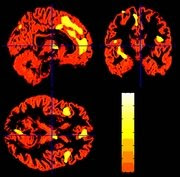
Areas in the brain that has minor volume of grey matter, among those who were in the nearness of the terrorist-attack. All areas, which are light in colour on this picture, are areas that are connected with emotions. (Foto: Barbara Ganzel/Cornell University)

”Traumas can change the brain” was the heading to an article I got a link to. It stands that evil experiences as those happening September 11 at World Trade Center can reduce the amount of grey matter in the brain. See "Resilience after 9/11: Multimodal neuroimaging evidence for stress-related change in the healthy adult brain" andBrain's gray cells appear to be changed by trauma of major events like 9/11 attack, a study suggests.

Unprocessed trauma makes the brain vulnerable for new trauma? The less traumatized (or the more help an individual has gotten to process difficult things from early in life r later in a successful, proper therapy) the less vulnerable, the more easily you can process difficult life-events later. What Jenson says!! Unprocessed traumas influence our ability to process later traumas so we can go on in life better.

I had to look in Jenson’s book again. Yes, she writes at page 36 that another serious consequence of a permanent suppression is the distortion (förvrängning) the unconscious forces us to. She means that we aren’t aware of what and how we are actually behaving and doing (these defence and survival strategies comes automatically, and have become as a part of ourselves, in my understanding and interpretation of her, we need to learn to recognize them first), for instance trying to change oneself in hope of getting appreciation and/or be spared abuse and violations.

An inborn ability to process experiences is damaged. And she means that to be capable of processing things realistically and in full a person needs to see clearly what’s happening in a given situation. When there is a high degree of denial clear perception is rather exception than rule. The unconscious distorts the individual’s experiences without her/him being aware of it.

Suppression damages a very important human capacity namely the ability to process experiences, something which is important for a sound, satisfying life. And the results of these inabilities are often quite tragic I would frankly say.

Of course this influences later difficult experiences and our capacity to process them constructively.

And that is what the researchers have seeing the research that is referred to?

See wikipedia according grey matter in the brain, and the ACE-reporter nr. 4 ”Adverse Childhood Experiences and Stress: Paying the Piper” where it for instance stands:

“…the ACE Study data [was analyzed] against demonstrated neurobiological defects that result from early trauma, changes to areas of the brain that mediate mood, anxiety, healthy bonding with other people, memory, and even where our bodies store fat.

After careful analysis, what they found is that ‘early experiences can have profound long-term effects on the biological systems that govern responses to stress…Disturbances [in neuron-development] at a critical time early in life may exert a disproportionate influence, creating the conditions for childhood and adult depression, anxiety, and post-traumatic stress symptoms.’

These shared findings have ‘the potential to unify and improve our understanding of many seemingly unrelated, but often co-morbid [occurring at the same time] health and social problems that have historically been seen and treated as categorically independent in Western culture.’

Why is this important? First, it is important to recognize that our ‘functional neuroanatomical and physiologic systems are interactive and integrated and that behaviors and health problems cannot generally be attributed to the function of any single or particular system.’ Our bodies’ systems work together. Therefore, treating one aspect of a problem, without addressing the other aspects, cannot possibly solve the problem completely.

Comprehending this essential relationship can help improve both preventive and primary care medicine, giving patients and their caregivers the information they need to achieve the best possible health and social outcomes.

Second, this convergence of colleagues and their data ‘adds support for numerous effects of childhood adverse experiences on physical health.

Stress is known from animal studies to be associated with a broad range of effects on physical health, including cardiovascular disease, hypertension, hyperlipidemia, asthma, metabolic abnormalities, obesity, infection and other physical disorders.’ These findings provide the sort of substance that governments, organizations, and people in general typically require to become engaged, and to take action.

Without scientific data, the long-term effects of childhood trauma are otherwise easily brushed aside in favor of a more comfortable and convenient denial of the problem.

Third, we now know that ‘retrospective reports of childhood abuse [that was documented at the time of its occurrence] are likely to underestimate actual occurrence…[due to] effects of traumatic stress in childhood on the hippocampus’. In other words, the incidence of child abuse is probably much greater than is reported, and even greater than remembered and acknowledged by the victims themselves. Not only is such trauma protected by secrecy and shame, but by the function of our own brains.

Equally important, this multi-disciplinary approach to research encourages future collaboration among scientists, all working at solving different pieces of what we are beginning to understand is the same puzzle. As the puzzle takes shape, the pipers lose ground.”

In wikipedia it stands about the grey matter:

“Grey matter is distributed at the surface of the cerebral hemispheres (cerebral cortex) and of the cerebellum (cerebellar cortex), as well as in the depth of the cerebral (thalamus; hypothalamus; subthalamus, basal ganglia - putamen, globus pallidus, nucleus accumbens; septal nuclei), cerebellar (deep cerebellar nuclei - dentate nucleus, globose nucleus, emboliform nucleus, fastigial nucleus), brainstem (substantia nigra, red nucleus, olivary nuclei, cranial nerve nuclei) and spinal grey matter (anterior horn, lateral horn, posterior horn).

The function of gray matter is to route sensory or motor stimulus to interneurons of the CNS in order to create a response to the stimulus through chemical synapse activity. Gray matter structures (cortex, deep nuclei) process information originating in the sensory organs or in other gray matter regions. This information is conveyed via specialized nerve cell extensions (long axons), which form the bulk of the cerebral, cerebellar, and spinal white matter.”

See earlier postings on the brain and also the posting on hysteria and neocortex.
