Visar inlägg med etikett ACE-study. Visa alla inlägg

2/11/2010

The enormous importance of the parenting and care taking style and of not exposing children to stress...

A quick blogposting in the morning, spontaneously thinking loudly.

Read the article ”How Childhood Trauma Can Cause Adult Obesity”.

Reducing the stress, already for the not born baby and by treating it with the greatest respect during its whole childhood (and understanding its "inadequate" reactions), is of enormous importance, not only for the individual and her/his future life and life quality, but also for the society and the world.

With other words we have to treat the children with love, genuine love, and if we can't genuinely love we should be willing to explore why; if it has with us or in fact with the child to do. Maybe what the child is triggering in us.

But if you became stressed and didn't get what you needed early I think you can recover later, with a lot of work though, and recover if your painful experiences aren't/haven't been played down. And by that adults recognize what is actually painful, thus needed to be repressed and/or played down, experiences that are still remaining in the body with all what that means, for the individual and her/his environment wherever this person is in the society.

And this has nothing to do with forgiveness. Even if forgiveness probably can feel good for the moment, because what you are ding when you are forgiving is to deny (more or less) what was done and how painful and even harmful and not right it actually was (meeting evil with evil doesn't solve anything, not even when it comes to a parent meeting a small child's evilness with punishments).

See what Alice Miller has written about this with forgiveness, for instance in "Decepetion Kills Love."

Also see the preface to Alice Miller's book "From Rage to Courage."

And it's crucial how we meet children who have already become traumatized and who are stressed (maybe showing it in hyperactivity) later on. That we are willing to listen to them and not expose them for even more stress and pressure. I'm very critical to the current school politics and they who are responsible for it (and oher politics) in the Swedish government today. See David Korten being shocked that countries like Sweden are on their way of copying his home country USA when it comes to economic politics (causing increasing inequality with everything that follows in the footsteps of this).

And what is hyperactivity about? What is ADHD etc. actually?

The article points out that a child being exposed to another parenting style than her mother's (father's or parents') changes her/his future parenting style. So a child born to a neglectful parent who is raised by a caring caretaker becomes a caring caretaker for her/his children later.

The article also refers to research showing that early stress causes a lot of health troubles of different kinds. Troubles that could become avoided.

I think those (we) could be healed to different degrees if they (we) were allowed to admit to the things we have been exposed and were allowed to call early (and later) experiences in question.

Also read the blogposting (my translation of the heading of the posting from Norwegian to English, but the text in the posting is in English) "Adverse Childhood Experiences and Psychosis."

7/27/2009

It lies in the profit's interest that stress becomes individualized...

af Chapman, Stockholm, with the Royal Palace in the background.

[Updated July 28]. The Swedish professor in religion psychology Owe Wikström writes in his book “In praise of the slowness – or the danger of driving moped though Louvren”(2001) in my quick amateur-translation from Swedish that:

“Laying the blame for exhaustion on the individual solely is directly devastating, especially in times when fewer people has to do more things on a shorter time.

It lies in the profit's interest that stress becomes individualized [and that people start to blame themselves!!! Who are blaming themselves and who are not? The ones that ought to?? Or? We are punished for other people's doings???].

Structural reasons are momentary more expensive to take care of, but cheaper in longterm for the [whole] society.

That's the reason why it's important that the slowness' culture isn't made banal or becomes reduced to the private individual's task. It's also about politics and society.”

But of course each individual has a responsibility for her/himself, what she/he does to other people, to and for the society too!! But those two things, each individual's responsibility and the responsibility those with more power have, doesn't have to exclude each other or how you shall express it. There ARE things (structural) you can't master on your own!

Addition in the evening: Read Sunder Katwala (Guardian) in "When is inequality unfair?" And Paul Krugman in "Kings of Pain."

Addition July 28: When I read George Montbiot in "Politically Transmitted Disease" I had to smile a little. He ends his article with:

”When Unicef compared teenage pregnancy rates in different parts of the world, it found that the Netherlands had the rich world’s lowest incidence – five births per 1000 girls – and the US had the highest: 53 per 1000(16). Unicef explained that the Dutch had 'more open attitudes towards sex and sex education, including contraception.' There was no 'shame or embarrassment' about asking for help. In the US, however, 'contraceptive advice and services may be formally available, but in a ‘closed’ atmosphere of embarrassment and secrecy.'

Obama’s new budget aims to change all this, by investing in 'evidence-based' education programmes(17). The conservatives have gone ballistic: evidence is the enemy. They still insist that American children should be deprived of sex education, lied to about contraception and maintained in a state of mediaevel ignorance. If their own children end up with syphilis or unwanted babies, that, it seems, is a price they will pay for preserving their beliefs. The denialogues are now loudly insisting that STDs and pregnancies have risen because Bush’s programme didn’t go far enough. The further it went, the worse these problems got.”

Education and talking openly about those things seem to be preventive!! Even though some maintain that other programmes with worse results didn't go far enough.

He starts it as follows:

“All of us are in denial. Without it we couldn’t get through life. Were we to confront the implications of mortality, were we to comprehend all we have done to the world and its people, we wouldn’t get out of bed in the morning. To engage comprehensively with reality is to succumb to despair. Without denial there is no hope.

But some people make a doctrine of it. American conservatism could be described as a movement of denialogues, people whose ideology is based on disavowing physical realities. This applies to their views on evolution, climate change, foreign affairs and fiscal policy. The Vietnam war would have been won, were it not for the pinko chickens at home. Saddam Hussein was in league with Al Qaida. Everyone has an equal chance of becoming CEO. Universal healthcare is a communist plot. Segregation wasn’t that bad. As one of George Bush’s aides said, 'We’re an empire now, and when we act, we create our own reality.'

Collective denial has consequences. A new study by the US Centers for Disease Control (CDC) shows that during the latter years of the Bush presidency, America’s steady progress in reducing teenage pregnancies and sexually transmitted diseases was shoved into reverse(2).”

4/25/2009

Leaders and child abuse…

people lived here 6000 years ago (stone age).


From Bob Scarf’s essay “Leaders”:

"This is consonant with the idea that ‘leadership’ is composed of the most backwards psychoclasses.

Question: Why is that? That is, why is ‘leadership’ composed of the most backwards psychoclasses? /…/

I have written elsewhere (and in previous posts) on the origins of political power [and why are some given power? Why does the people give certain people power, even the highest power in a society, whether formal or informal, on different levels? What do those have in their early history?].

In the gynarchy (female subculture) women restaged their abuse and warded off their annihilation anxiety by emulating their abusive mothers.


In the androcracy (male subculture) men, who did not become mothers, had to restage and combat their annihilation anxiety in other ways. One of the ways they did so was by developing politics and political power [or in anger]. So power is pathological. If you want to avoid using medical terms; power is a defense. It follows then that the people who are more defended (in certain ways) are more attracted to political power.

[and power in general in the society!?
I think the ones that would become the best leaders, for instance on workplaces, don’t seek those jobs, because they realize the problems with being a leader. The researchers Christina Maslach and Michael P. Leiter thought the workplaces and companies were at risk of becoming drained on their best work labor, because either they would become burnout or try to leave and start their own businesses, with all the troubles connected to this and what this would cost for the companies, workplaces, the democracy the society, the societal economy. And so far I have had the incomes so I can buy and read a lot of books. More privileged than many in this world, even though I only have middle-incomes! Grew up and still belong to the middle class, maybe grew up in the somewhat upper middle class].”

See what Alice Miller writes in her book "The Body Never Lies" and what's written about its content (the second half of this posting) concerning child abuse and the society.


I thought further on my maternal grandparents and how they survived the pressure on them (in the working class. Addition: I think I belong to the “working” class too!).


We live in much more complicated societies than our first ancestors lived, in societies with the potential to really destroy everything on this earth; the nature, all human beings.


My great grandparents and their generation, and in the generations before them, didn’t really have those means.


I also came to think how does the history look when it comes power-mad? To money and property mad (having limitless needs, needs that can never become filled, the person never becomes satisfied, is about persons trying to fill needs they can never fill afterwards, because that time has passed, but what does this cause other people, if not the whole society, but the persons nearest to them)?


And societies with many disturbed because of the ways that were in fashion raising children (as for instance in Germany decades before WWII, and probably also occurring in societies in wars and lots of conflicts today too)?


That our grandparents (in my generation), being under and standing with their caps in their hands, bowing for their employers managed their lives (in greater poverty than almost all people today?) how did they? Were they stronger, or what? The illnesses came late in life for them. See about the ACE-study. I think Miller wonders if Hitler had needed his leader role (that much) if he had a lot of children, and been able to abreact the horrible abuse he endured during his childhood on them.


Did they because they could abreact their frustrations on their kids, it was your duty to educate your children, and the method was spanking them and making so they didn’t think they were anybody (by using emotional and verbal violence)?


Men abreacted on their wives and kids if they weren’t in a power position (then they probably mistreated the persons standing them nearest in different ways, more or less subtle), and women in turn on their kids (if they couldn’t react at their husbands, on whom they were dependent)?


Women abreacted the abuse they had endured during their childhood (and their under order in the whole society) and their fear of becoming annihilated by copying their mothers (and/or fathers). Men sought power in the society, and if this wasn’t possible they abreacted their early experiences and latter humiliation they experienced in the society, at work etc. too on their kids (and wives. But women have been abusive too at not only their kids!). As was the case when I grew up.


In this way they survived, didn’t become sick in the first place, and had a feeling of some sort of power and control (the therapists Ingeborg Bosch and Jean Jenson, maybe among others, think you get a feeling of power and control through anger and/or denial of needs) ?


Also came to think: Owe Wikström realized when his heart all of a sudden stopped and during the recovery after this, how totally being at the mercy and dependent he was on his caregivers, and the care and good will he got from them [my addition: that they didn't abuse his situation]. See what his reflections in his book “Sonias goodness”.


I also wondered: real equality, real freedom, (that all people have the same say, are equally worth, get the same respect as everybody else) in the society and the world is that the real prerequisites? How do we create this? The best and probably only method is changing childrearing methods even more than we have already done? There’s still quit a lot to do there I would say.


Interview with the author Henning Mankell.

1/30/2009

Increasing child abuse...

Göran Harnesk.

[Addition January 31, see the end of this posting]. A Swedish blogger Jenny Westerstrand, PhD in law, wrote an angry blogposting triggered by an article in one of the biggest newspapers in Sweden that the abuse of children is increasing in Sweden. Despite our ban on corporal punishment children are beaten! And this is horrible, and in fact crime! Not only a moral crime. And it causes damage, real physical (neurological) damage. Also see the ACE-study's findings (see link in the labels in the end of this posting!).

”Help, do something!”

she writes (see earlier blogpostings about her writings here). And wishes that any of our most courageous journalists, with sense for justice (and with a hidden camera), would make TV-programs about this.

“It’s so shocking so one want to cry.


Child abuse is increasing and many children are exposed to awful actions [and conditions] by their parents, almost always it’s the father that is the abuser Children’s Right in Society (in Sweden) says.


What are the Swedish men, young as old, doing? Because young women are calling Bris [Children’s Right in Society] and telling that they are abused by their boyfriends too. Why can’t we get any journalism not only telling us about innocent men for a while, but a journalism that sees it from the children’s perspective and dig into the world where violence is an everyday life context for small human beings who are totally defenseless in their own homes, with their own swine skunks to – mostly – fathers.”

Each tenth child is beaten the article says.


The number of children calling Children’s Right in Society to tell about abuse further increased during 2008 (see this report in English). And who are calling? Not the youngest. What are they exposed to?


During the last five years the number has increased with 20 percent.


The Convention of the Rights of the Child says that children has right to become protected from physical and psychological violence (Article19, see here for all the articles).


Last year Children’s Right in Society got almost 22,000 contacts from children and adolescents around Sweden, 30 years after we got the ban on corporal punishment and 20 years after the United Nations Convention of the Right of the Child.


The report from Children’s Right is gloomy reading.


In almost each tenth contact children were telling about physical and psychological abuse. The report is terrifying reading.


Children have told about routine-like violence, where they have become beaten and sometimes even been beaten with weapons like belt and sticks daily, but some have also told about more torture like violence. And some children have also told about how they have become shaken and beaten till they lost the consciousness.


When children are exposed to violence the perpetrator is often a parent, almost always the dad. My addition: but I know of cases where the mother was the main abuser.


According to the report the violence is combined with psychological violence where the children are told that they aren’t loved and worthless and that that’s the reason why they are beaten.


How horrible, and not true! Nobody “deserves” being abused how “worthless” they even are!


Many calls come from young women telling that they have become beaten by their boyfriends. The girl has often moved from home to an older boyfriend (and why is that?) and is exposed to both physical and psychological abuse.


They realize that they maybe are badly treated, but they don’t dare to tell anybody, because they think they have to blame themselves because they have chosen this relation themselves.


One of five children expresses some kind of anxiety. It can be anxiety and agony in children living with violent and abusing parents, worry for friends or anxiety as an expression for psychological ill-health (no wonder the ill-health!).


Some children experience that they are let down by the society. When they have told other adults, as teachers and personnel in social services about the abuse they haven’t gotten any reaction.

“It’s frightening realizing that the children have told something [and somebody] but nothing happens. They are not taken seriously, “

the director-.general for Children’s Rights in Society Göran Harnesk says.


Many children express a fear for the duty to report, a duty which means that all working with children has a duty or obligation to report social evils (bad conditions), because the contact with the parents then is at risk of getting worse.


I would also want to write about an article in Norwegian about “Psychologists are lacking self-knowledge (self-understanding). The psychology profession is lacking capacity to see its own political impact and has overseen the growth of the therapeutically culture.” Addition February 1: see here.


I think they (psychiatrists, psychologists, therapists etc.) too often run the errands of the power! Trying to adapt people to the “culture” in the society and at workplaces (as schools are for children and young people) where they live and work, instead of really questioning it… Are they adapting people to a sick culture that should become changed rather?


Addition January 31: also see this blogposting, about "Normalisation of abuse." I want to write about this posting later too.

10/08/2008

Stress increases the risk for rheumatism...

Lars Alfredsson.


Yes, stress can cause different sorts of rheumatism, not only rheumatoid, but also for instance polymyalgia rheumatica, which a person near to me maybe has. A person probably suffering from longterm stress, and with a history of child abuse of different kinds. Abuse that is denied, or in parts recognized but considered having no real significance for this person's life, from that person herself, and probably many around her.


Thought of blogging about something I thought was interesting, from a Swedish site called Suntliv.nu. I want to start with relating to the content in the article:


Low control at work increases the risk for rheumatoid arthritis. A new Swedish study shows that the one who doesn’t decide over her/his work situation runs the risk of getting rheumatoid arthritis. It’s an endemic disease with over 50,000 people stricken by it in Sweden (with a population of 9 million people). Women are more often stricken than men.

“We have found clear connections between the disease and works where you can’t control your situation,”

the Swedish professor Lars Alfredsson says.


Other factors for getting ill are smoking and low education.


The researchers have also found some unexpected connections, namely between stress at work and rheumatoid arthritis.


The ones with low space for (own) decisions have a 60 % higher risk of being stricken.


The researchers also classified people in different professions after how low respective high control they have and compared people in professions with low control with people with high control concerning the risk of getting ill.


In that investigation they showed that it is 30 % higher risk for people in professions with low control to get ill.


Stress causes inflammation they mean and think it’s possible that stress makes inflammation come up.


Studies abroad has shown that the ones stricken with rheumatoid arthritis often have had a period of stress or experienced something revolutionary before the debut of the disease.


The researchers have also asked the participants about different sorts of stress and are now analyzing the connections between stress, results which are going to become presented later.


The study is also about interplay between inheritance and milieu.


My loud thinking around this article: I read this article after I had blogged about the young woman Veronika with rheumatoid arthritis whose psychiatrists didn’t believe her when she said she had been raped, and who showed to have been sexually abused as a child too.


I also came to think of two men I know of who got rheumatism as adults, one after a divorce in middle age and the other when he had passed 75 I think. The latter also got heart problems at the same time. I wonder over the latter and the relation he lives in and possible stress in that relation, a relation that easily could make you feel a little out of control?


The latter man was spanked as a child I think. Something he doesn’t seem to really question or view as wrong, or really rebel against. Something that was natural then and "what all parents did” because they "didn’t know better"?


I think I have read somewhere about connections between spanking and rheumatism too.


Thinking loudly, and trying to put something in words I am not really capable of putting in words yet. Being in a relation or maybe situation feeling a low control could also be a feeling that is fooling a person... Because he or she can actually have the power to leave it in may cases. But is feeling stuck and power and helpless, maybe even feels paralyzed (as the child ones was). Early feelings that are triggered in the present and feels so real so the person doesn’t see any alternatives, truly doesn’t see them. But those feelings stemming from early events in this persons life aren’t just to control. As we think we can. And are nothing to moralize over...

6/10/2008

Traumas and changes in the brain...

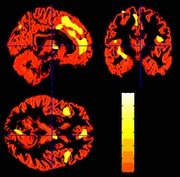
Areas in the brain that has minor volume of grey matter, among those who were in the nearness of the terrorist-attack. All areas, which are light in colour on this picture, are areas that are connected with emotions. (Foto: Barbara Ganzel/Cornell University)

”Traumas can change the brain” was the heading to an article I got a link to. It stands that evil experiences as those happening September 11 at World Trade Center can reduce the amount of grey matter in the brain. See "Resilience after 9/11: Multimodal neuroimaging evidence for stress-related change in the healthy adult brain" and ”Brain's gray cells appear to be changed by trauma of major events like 9/11 attack, a study suggests.”

Unprocessed trauma makes the brain vulnerable for new trauma? The less traumatized (or the more help an individual has gotten to process difficult things from early in life r later in a successful, proper therapy) the less vulnerable, the more easily you can process difficult life-events later. What Jenson says!! Unprocessed traumas influence our ability to process later traumas so we can go on in life better.

I had to look in Jenson’s book again. Yes, she writes at page 36 that another serious consequence of a permanent suppression is the distortion (förvrängning) the unconscious forces us to. She means that we aren’t aware of what and how we are actually behaving and doing (these defence and survival strategies comes automatically, and have become as a part of ourselves, in my understanding and interpretation of her, we need to learn to recognize them first), for instance trying to change oneself in hope of getting appreciation and/or be spared abuse and violations.

An inborn ability to process experiences is damaged. And she means that to be capable of processing things realistically and in full a person needs to see clearly what’s happening in a given situation. When there is a high degree of denial clear perception is rather exception than rule. The unconscious distorts the individual’s experiences without her/him being aware of it.

Suppression damages a very important human capacity namely the ability to process experiences, something which is important for a sound, satisfying life. And the results of these inabilities are often quite tragic I would frankly say.

Of course this influences later difficult experiences and our capacity to process them constructively.

And that is what the researchers have seeing the research that is referred to?

See wikipedia according grey matter in the brain, and the ACE-reporter nr. 4 ”Adverse Childhood Experiences and Stress: Paying the Piper” where it for instance stands:

“…the ACE Study data [was analyzed] against demonstrated neurobiological defects that result from early trauma, changes to areas of the brain that mediate mood, anxiety, healthy bonding with other people, memory, and even where our bodies store fat.

After careful analysis, what they found is that ‘early experiences can have profound long-term effects on the biological systems that govern responses to stress…Disturbances [in neuron-development] at a critical time early in life may exert a disproportionate influence, creating the conditions for childhood and adult depression, anxiety, and post-traumatic stress symptoms.’

These shared findings have ‘the potential to unify and improve our understanding of many seemingly unrelated, but often co-morbid [occurring at the same time] health and social problems that have historically been seen and treated as categorically independent in Western culture.’

Why is this important? First, it is important to recognize that our ‘functional neuroanatomical and physiologic systems are interactive and integrated and that behaviors and health problems cannot generally be attributed to the function of any single or particular system.’ Our bodies’ systems work together. Therefore, treating one aspect of a problem, without addressing the other aspects, cannot possibly solve the problem completely.

Comprehending this essential relationship can help improve both preventive and primary care medicine, giving patients and their caregivers the information they need to achieve the best possible health and social outcomes.

Second, this convergence of colleagues and their data ‘adds support for numerous effects of childhood adverse experiences on physical health.

Stress is known from animal studies to be associated with a broad range of effects on physical health, including cardiovascular disease, hypertension, hyperlipidemia, asthma, metabolic abnormalities, obesity, infection and other physical disorders.’ These findings provide the sort of substance that governments, organizations, and people in general typically require to become engaged, and to take action.

Without scientific data, the long-term effects of childhood trauma are otherwise easily brushed aside in favor of a more comfortable and convenient denial of the problem.

Third, we now know that ‘retrospective reports of childhood abuse [that was documented at the time of its occurrence] are likely to underestimate actual occurrence…[due to] effects of traumatic stress in childhood on the hippocampus’. In other words, the incidence of child abuse is probably much greater than is reported, and even greater than remembered and acknowledged by the victims themselves. Not only is such trauma protected by secrecy and shame, but by the function of our own brains.

Equally important, this multi-disciplinary approach to research encourages future collaboration among scientists, all working at solving different pieces of what we are beginning to understand is the same puzzle. As the puzzle takes shape, the pipers lose ground.”

In wikipedia it stands about the grey matter:

“Grey matter is distributed at the surface of the cerebral hemispheres (cerebral cortex) and of the cerebellum (cerebellar cortex), as well as in the depth of the cerebral (thalamus; hypothalamus; subthalamus, basal ganglia - putamen, globus pallidus, nucleus accumbens; septal nuclei), cerebellar (deep cerebellar nuclei - dentate nucleus, globose nucleus, emboliform nucleus, fastigial nucleus), brainstem (substantia nigra, red nucleus, olivary nuclei, cranial nerve nuclei) and spinal grey matter (anterior horn, lateral horn, posterior horn).

The function of gray matter is to route sensory or motor stimulus to interneurons of the CNS in order to create a response to the stimulus through chemical synapse activity. Gray matter structures (cortex, deep nuclei) process information originating in the sensory organs or in other gray matter regions. This information is conveyed via specialized nerve cell extensions (long axons), which form the bulk of the cerebral, cerebellar, and spinal white matter.”

See earlier postings on the brain and also the posting on hysteria and neocortex.

4/18/2008

Psychosocial stressors in children…


from the Swedish child-film Dunderklumpen (1974, English site here and Swedish here), I have played the first tune with a couple of pupils.

Peter Währborg (see former posting "Empathy and Stress...") also writes about children and psychosocial stressors at page 79-81 in his book (mentioned in the former posting).

He writes that in the main the same things which are stressing children are stressing adults.

The most important stressors are emotionally significant separations, for instance parents divorce, but also getting new teachers and classmates. When children loose a part of the body because of illness or accident they react with a powerful stress reaction, as when a person whom is important dies or moves. Children lives in a world which is a little bigger than adults understand Wärhborg writes.

Discomfort (vantrisel) being in a school and a class which only causes social and psychic suffering is of course not fun and causes (sometimes severe) stress in children. If you experience (thinks) you don’t manage especially well in school each failure gives new proofs on your insufficiency or inadequacy. The self esteem is jeopardized, and the inability to live up to the demands parents, teachers or others put turns into chronic stress.

Difficult relations are another source of stress in children. It looks as children in this case reacts more equal to grown up women, i.e., they react more pronounced on difficult relations than men do.

Children have many different sorts of relations which can play a significant or important role for the risk developing stress (my addition: and for minimizing the bad effects?).

Especially powerful are the stress reactions in children exposed to insulting “specific treatment” (särbehandling) or victimization (?) such as mobbing. (See this pdf-file on "Victimization at Work" from the Swedish National Board of Occupational Safety and Health).

Währborg thinks that children’s sensitivity means that the best would be if the classes were small and stable.

Encroachments (abuse), accidents, maltreatment or other severe traumas also causes stress. Sometimes this stress state is of a more serious nature, so called Post Traumatic Stress Syndrome. Not least children who have immigrated can carry things with them that they haven’t got any opportunity to process.

Währborg also mentions time and decision conflicts as a source for stress reactions in children something we also see in adults. When children feel powerlessness or that they don’t have control over their situation they react with stress.

Children suffer more seriously because of lack of security and social stability. The family-situation plays an important role in this (in moderating, and in moderating both this and that?). Here it isn’t only a question of interaction-patterns in the family but also about events happening to the family.

My brief reflections: We have tended to minimize and belittle things children experience, and to sweep it under the rug? And it was even more so earlier? If you didn’t talk about bigger and smaller events or traumas they didn’t harm one thought. And the child and whole events became surrounded by silence.

See about the ACE-study here and here.

3/19/2008

The ACE-study...

ACEs are surprisingly common among people of all social strata, and have far-reaching consequences. For many people, it's not possible to "just get over it". Or just walk out from a bad relation etc.

What's an ACE (Adverse Childhood Experience i.e. "skadlig barndomserfarenhet")?

Adverse Childhood Experience is growing up experiencing any of the following conditions in the household prior to age 18:

  • 1. Recurrent physical abuse
  • 2. Recurrent emotional abuse
  • 3. Contact sexual abuse
  • 4. An alcohol and/or drug abuser in the household
  • 5. An incarcerated household member
  • 6. Someone who is chronically depressed, mentally ill, institutionalized, or suicidal
  • 7. Mother is treated violently
  • 8. One or no parents
  • 9. Emotional or physical neglect
And I found the following text on the site “The Lamplighters”, which is a community partner to the ACE-study:

Do you fit the profile of a victim of incest or child sexual abuse?

Check any of the following individual behavior patterns that fit you.

  1. People-pleasing and rescuing
  2. Insomnia
  3. Excessive need to control
  4. Obsessive, compulsive behavior patterns
  5. Needy
  6. Low self-esteem
  7. Suicidal
  8. Weak boundaries
  9. Unhealthy choices in members of the opposite sex
  10. Neurotic tendencies
  11. Addictions: drugs, alcohol, sex, food, relationships
  12. Eating disorders
  13. Chronic illness
  14. Manic-depressive behavior (emotional extemes of highs and lows)
  15. Severe depression

Now it's time to take a look at the other common denominators of a child who has been sexually abused, the family system ones. This is the forest that your trees (the individual common denominators) grew under. Check which of the following family systems common denominators fit you.

  1. Patriarchal (or matriarchal) family system
  2. Obedient/co-dependent mother (father)
  3. Religiously regimented household
  4. Eldest daughter
  5. Alcoholic (or other addiction) parent
  6. Family history of sexual boundary violators

Are you starting to see the picture?

It's never too late to get into incest recovery or recovery from child sexual abuse, sexual assault, rape or domestic violence.

About “Authentic Voices International” it stands:

“The Value of a Voice.
We believe that by telling the stories of our lived experiences, we can
help dispel the secrecy and shame that keep people from moving on
toward a brighter future.”